Top 7 Balustrade Concrete Molds for 2026
On a dusty jobsite at dusk, a contractor crouches beside a fresh rail section and checks the curve against the last few pieces lined up nearby. He is not admiring the work. He is looking for drift — a softened edge here, a slight bulge there, a seam that means extra cleanup before the crew goes home.
If you are comparing balustrade systems for a project, that moment tells you almost everything that matters. Whether you are replacing 6 broken units on a front stoop in Brooklyn or planning 60 matching pieces for a hotel terrace, the design and fabrication approach affects consistency, release, finish labor, and how confidently you can repeat the same profile.
This guide is for homeowners, builders, architects, contractors, and property owners working on residential or commercial projects in 2026. We start with the decision framework first, then walk through seven common options in the same simple scan: what it is, what it is best for, and what to watch before you move forward.
Selection Criteria for Balustrade Systems
Material and durability
Material choice changes how a balustrade component behaves after the first few pours. Rigid forms tend to hold their shape better across repeated production, which helps keep balustrades consistent. That matters a lot more on a 24-piece stair run than on a one-time garden project.
Fiberglass and steel usually win on shape retention. Flexible materials often win on release. Neither category is “better” by default — you are really choosing which problem you would rather manage: distortion, fragile demolding, or faster wear.
Surface detail and ease of release
A balustrade’s surface finish and release behavior can decide how much rubbing, patching, and edge cleanup happens after stripping. If the cavity releases cleanly, you spend less time fixing arrises and less time chasing tiny defects along beads, flutes, or scrollwork.
On a plain profile, cleanup might be minor. On a decorative baluster with several narrow transitions, release becomes a daily labor issue. In 2026, labor is expensive enough that a “cheap” setup can get costly fast if every piece needs 15 extra minutes of handwork.
Project scale and reuse count
Count your pours honestly. A homeowner repairing a porch in Albany does not need the same tooling as a precast crew producing a long commercial rail. Small jobs can justify simpler, lower-cost approaches, while repeated production usually favors more durable tooling.
Think in batches, not wishful thinking. How many identical pieces do you need this month? How many next year? If the answer is 8, planning as if you need 80 rarely pays off.
| Approach | Rigidity | Detail capture | Reuse potential | Typical fit |
|---|---|---|---|---|
| Fiberglass | High | Good | High | Repeated mid-volume casting |
| Polyurethane | Medium | High | Medium | Decorative profiles |
| ABS plastic | Medium | Fair to good | Low to medium | Budget-minded, lighter handling |
| Rubber or silicone | Low on its own | Very high | Medium | Intricate shapes, easier release |
| Steel | Very high | Good | Very high | Industrial or high-volume work |
| Modular multi-cavity | Varies | Varies | High | Long repetitive runs |
| Custom CNC-machined | Varies by final mold | High to exact-match | Varies | Restoration or bespoke design |
Choose the approach that matches the number of pours you actually need, not just the lowest upfront price.
#1 Fiberglass Balustrade Systems
Best for: repeated production where one profile needs to stay one profile, pour after pour.
What it is
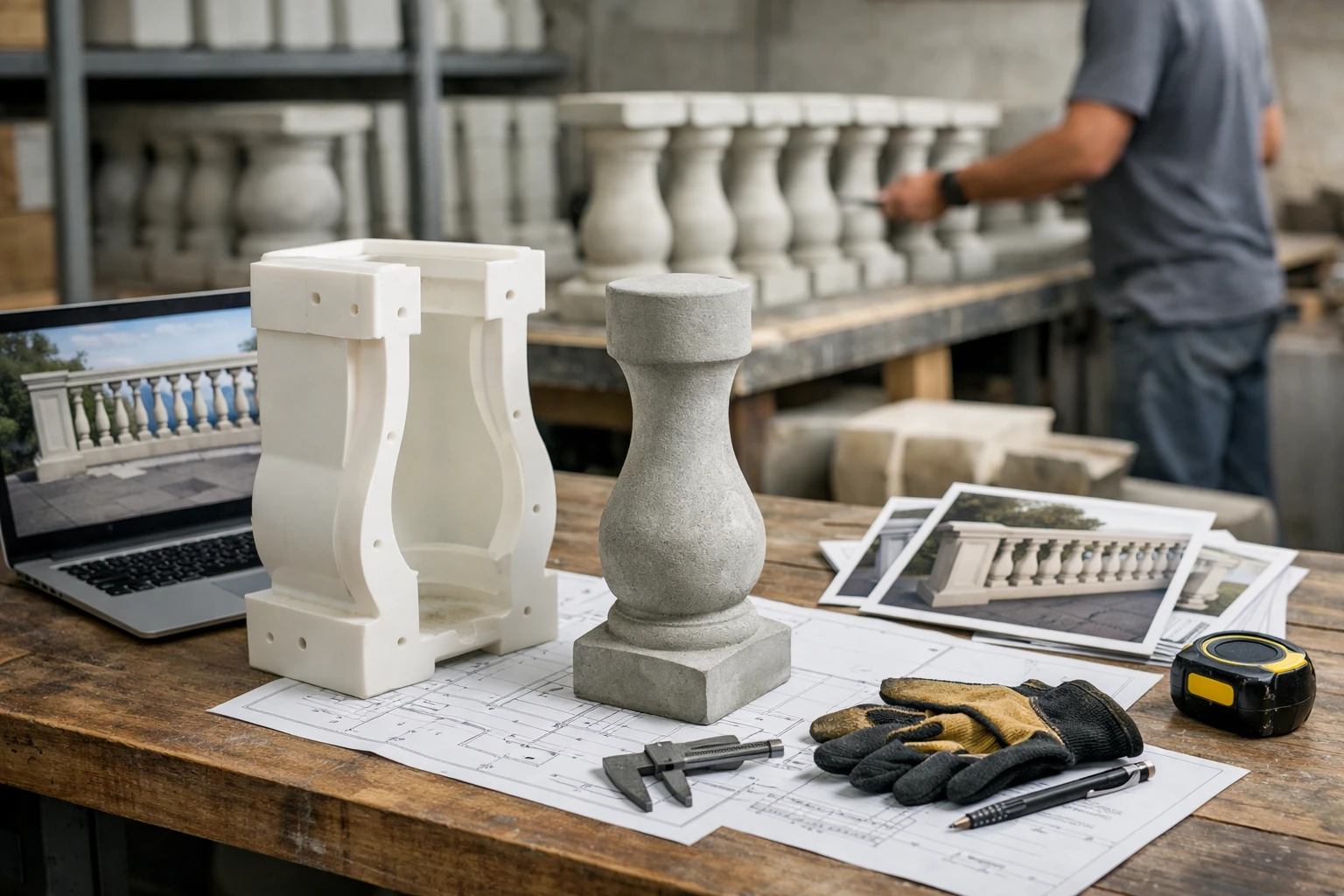
Fiberglass balustrade tooling uses a rigid shell that resists shape drift. It is commonly chosen when you need the balustrade profile to stay consistent from pour to pour, especially on standard architectural shapes used across porches, balconies, and stair rails.
Best for repeated production
If you are a contractor or builder making multiple matching sections, fiberglass is usually one of the safest middle-ground options. It has enough rigidity to keep 20, 30, or 50 pieces looking related, without stepping all the way into heavy industrial tooling. For many crews, that balance is the appeal.
Watch-outs before buying
Do not judge fiberglass only by the catalog photo. Check flange strength, seam quality, interior smoothness, and how the form will be supported on sawhorses or a table. A rigid shell with a rough interior can still leave you with seam cleanup and edge repairs. It also is not the first choice for deep undercuts or very ornate relief.
If you need the same profile over and over, rigidity and repeatability matter more than portability.
#2 Polyurethane Balustrade Systems
Best for: decorative profiles that need finer detail without giving up all shape retention.
What it is
Polyurethane forms sit in the useful middle ground between rigid plastic and very soft flexible options. They are widely chosen for capturing finer surface detail than many rigid plastic options, while still offering enough body to hold a profile reasonably well when supported correctly.
Best for decorative profiles
If your design includes fluting, beads, leafwork, or a more classical look, polyurethane deserves a hard look. Its flexibility can help with demolding on ornate shapes, which means fewer broken edges on detailed pieces. For a custom residential stair or a decorative terrace rail, that can save real time.
Tradeoffs to expect
Flexibility is helpful until it becomes too much of a good thing. Polyurethane may need backing support, careful handling, and better storage discipline than a simple rigid shell. On long runs, you should also think about how the material wears, because detail only matters if the edges still release cleanly on piece number 25.
Fine detail is useful only if the form still releases cleanly without damaging the edges.
#3 ABS Plastic Balustrade Systems
Best for: lighter handling, simpler profiles, and buyers keeping a close eye on budget.
What it is
ABS plastic forms are typically lightweight and easy to move, stack, and store. For a one-person setup in a driveway or a small shop, that lighter weight is not a small advantage. You feel it every time the form moves from storage rack to casting table.
Best for budget-conscious work
ABS makes the most sense when cost control matters more than highly ornate detail. If you are casting a straightforward profile for a short porch run or testing a design before scaling up, lighter plastic can be a practical entry point. It is also easier for homeowners or small crews who do not want heavy tooling.
Where it may fall short
Budget tools always have boundaries. ABS may not be the best choice for the sharpest architectural detail or for heavy repeated use. Support matters. Storage matters too — a lightweight form treated roughly in midsummer heat in Phoenix or stacked badly in a crowded garage is more likely to lose its edge, literally and figuratively.
Lightweight tools save labor, but they are not always the best choice for the most detailed architectural profiles.
#4 Rubber or Silicone Balustrade Systems
Best for: intricate shapes and cleaner release on decorative balusters.
What it is
Rubber or silicone-style forms are flexible options that can peel away from the casting rather than forcing the casting out of a hard shell. That flexibility is why they are commonly used when release behavior matters on more complex shapes.
Best for ornate surfaces
These forms shine when the profile is decorative and the surface has small details that you do not want to chip during demolding. If you are reproducing a patterned baluster for a historic veranda in Savannah or a highly ornamented stair, flexible release can protect the decorative work better than a rigid form.
Release and edge quality
Here is the tradeoff: flexibility helps preserve detail, but too much flex can work against crisp geometry. Without enough support, sharp edges can wander and long pieces can become harder to keep true. Many setups solve this by pairing the flexible cavity with a rigid outer support, sometimes called a mother mold.
Flexibility helps ornate designs come out cleanly, but too much flex can make it harder to keep sharp edges true.
#5 Steel Balustrade Systems
Best for: high-volume or industrial casting where durability and consistency come first.
What it is
Steel tooling is built for repeated use. In precast environments, it is commonly associated with long-lasting production equipment because it holds shape well, tolerates repeated cycles, and fits organized shop workflows better than lighter, more improvised setups.
Best for large production runs
If you are producing many identical pieces in a precast yard, steel starts to make a lot of sense. Commercial jobs, long facade runs, and repetitive rail work reward durability. When the same baluster profile needs to appear again and again across a large property, consistency beats convenience.
When the investment makes sense
Steel is not a casual purchase. It is heavy, harder to move, and usually overkill for a small residential repair. But when the tooling will pay for itself over many repeated pours, the math changes fast. That is why steel belongs in high-output environments, not in every garage workshop.
Heavy tooling makes sense when the form will pay for itself over many repeated pours.
#6 Modular Multi-Cavity Balustrade Systems
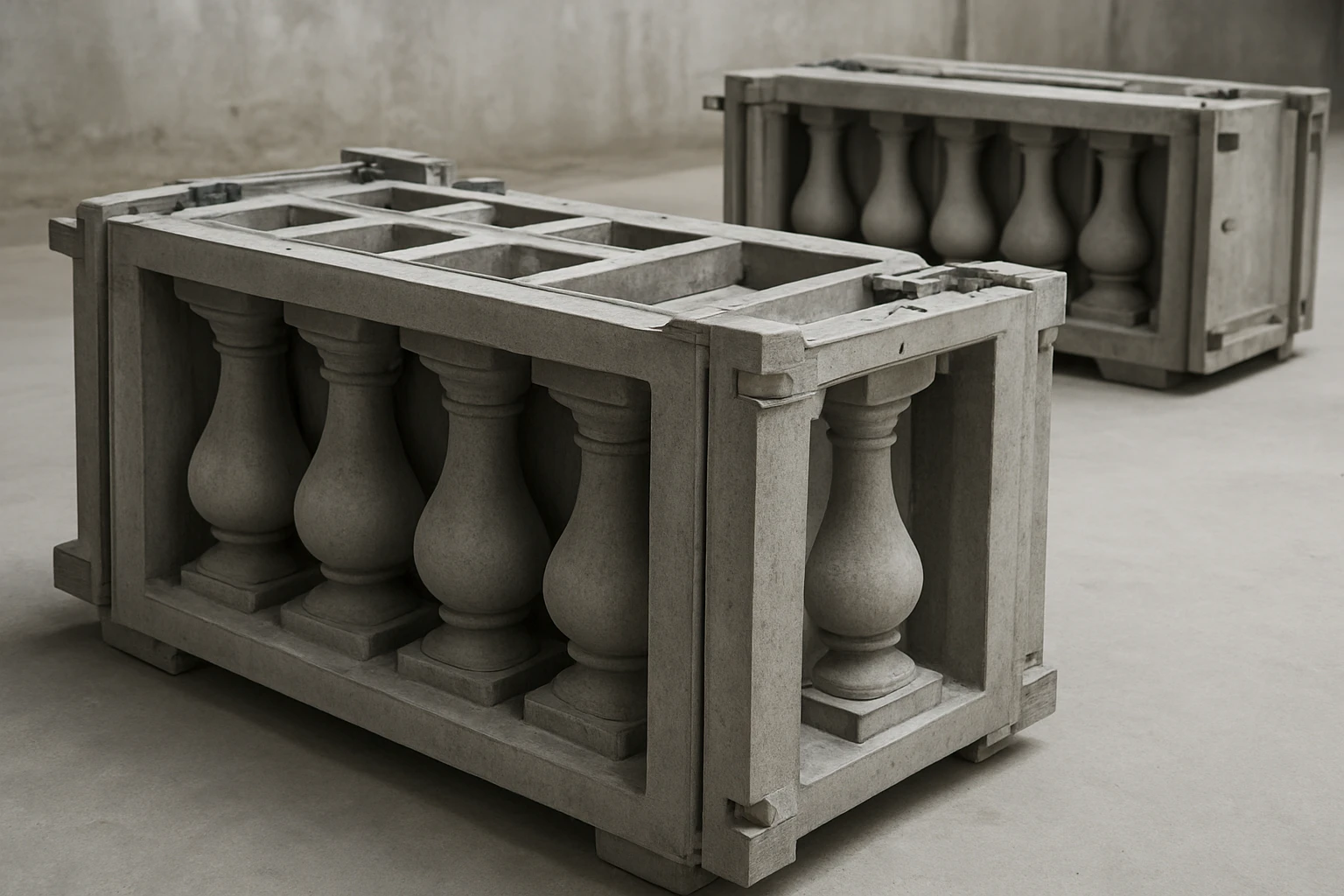
Best for: long runs of matching balusters and better output per setup.
What it is
A modular multi-cavity system casts several identical balusters at once instead of one at a time. Think of it as a productivity layout rather than a single form choice. The cavities may be made from different materials, but the real advantage is throughput.
Best for repetition and throughput
When a project calls for a lot of identical pieces across a long railing or facade, multi-cavity systems can increase output in a single setup. That is useful for 40-piece balcony runs, pool enclosures, or any job where the design repeats with little variation from unit to unit.
Coordination tips for long rail runs
Efficiency only helps if you stay organized. Use consistent mix batches, keep fill timing predictable, label pieces by sequence, and plan cure space before you pour. On long straight runs, small inconsistencies become obvious when the finished railing is viewed as a whole rather than one piece at a time.
When the design repeats a lot, production efficiency can matter more than having a single perfect cavity.
#7 Custom CNC-Machined Balustrade Systems
Best for: restoration work, exact architectural matches, and bespoke designs.
What it is
Custom CNC-machined work starts with a digital model or exact measured profile, then uses machining to create a master or component to precise dimensions. The finished production form may still be fiberglass, polyurethane, or another material — but the geometry begins with a much more exact setup.
Best for exact matches
This is the option for projects where “close enough” is not good enough. A restoration on a 1930s estate in Westchester, a courthouse stair, or a one-off residential design with unusual proportions can all justify custom machining. When the new pieces must sit beside existing architecture, precision matters.
When custom is worth it
Custom tooling costs more up front, no question. Still, it can be the cleanest path when the balustrade must match existing dimensions, code-driven spacing, or a unique design intent exactly. If the alternative is weeks of field adjustments and visual compromise, the higher first bill may be the cheaper outcome.
Custom tooling is expensive up front, but it can be the cleanest path when the balustrade must match existing architecture exactly.
How to Choose the Right Option
Match the form to the job size
Start with quantity. A small repair job often justifies simpler or lower-cost setups. Repeated production usually favors durable tooling that stays consistent longer. If your project is 8 pieces for a porch, you should not buy like a precast yard. If it is 80 pieces for a condominium rail, you should not buy like a hobbyist.
| Job scenario | Most logical option | Why |
|---|---|---|
| Short repair or small residential run | ABS plastic or polyurethane | Lower entry cost and easier handling |
| Mid-volume standard production | Fiberglass | Good balance of rigidity and reuse |
| Highly decorative profile | Polyurethane or rubber/silicone | Better detail capture and release |
| Large commercial or precast workflow | Steel or modular multi-cavity | Durability and throughput |
| Historic match or one-off custom design | Custom CNC-machined | Exact geometry and fit |
Balance finish quality against cleanup time
The more ornate the balustrade, the more important release behavior and detail retention become. A plain cylindrical profile forgives a lot. A classical piece with beads, necking, and carved ornament does not. If your crew spends half an hour patching each piece, the tooling choice is already costing you.
That is why you should look beyond the raw purchase price. In real jobs, finish labor is part of tooling cost. A setup that strips cleaner can be worth more than one that saves a little money on day one.
Decide whether reuse or customization matters more
If your design is standard and the quantity is high, reuse usually deserves the bigger share of your budget. If the architecture is unique, historic, or unusually dimensioned, customization deserves it instead. You are picking which form of waste to avoid: premature wear on one side, or endless correction on the other.
And be honest about whether you even need tooling. For some residential and commercial projects, buying finished architectural precast from a manufacturer such as Coral Cast can make more sense than owning a one-off form you may never use again.
- How many identical pieces do you really need?
- How much ornament must survive demolding without repair?
- Will you reuse the form next season, or is this a one-job decision?
The best choice is not the fanciest system; it is the one that fits the real number of pours, the required finish, and the available labor.
The best balustrade systems earn their keep by matching the job, not by looking cheapest in a catalog.
Rigid fiberglass and steel reward repetition. Flexible polyurethane, rubber, and silicone reward detail and cleaner release. Custom CNC work earns its place when exact matches matter more than the first invoice.
Before you decide, ask yourself one plain question: are you paying for a form, or for repeatability, finish quality, and fewer surprises on pour number 12?
Build Better With Coral Cast
Architectural precast concrete manufacturing gives homeowners, builders, architects, contractors, and property owners properly cured, maintenance-free precast and stone products from New York, plus showroom guidance and free estimates nationwide.