
Precast vs Cast Stone: 7 Differences That Actually Matter
On a dusty porch slab, a mason sets two sample profiles side by side while you hold the drawing flat with one hand and the tape measure with the other. One piece has the tight, cut-stone look you want around the entry. The other is close enough from six feet away, but not when you line it up with the sill height, the brick coursing, and the return at the jamb. That is usually the moment Cast Stone stops being a brochure term and starts becoming a job decision.
This is also where the phrase “precast vs Cast Stone” can trip people up. Cast stone is a refined artificial stone and a form of precast concrete, according to Wikipedia, so you are often comparing a broad material family with a more specific architectural application. If you start with the label, you miss what actually moves cost, risk, and appearance: location, exposure, profile accuracy, transport, installation, and proof of quality. On a 1920s brick facade in Brooklyn, those details show up fast.
Use the seven differences below the same way a careful team uses shop drawings — to confirm what belongs on the building before the first unit is poured, shipped, or set in mortar.
| Difference | What To Confirm First | Why It Matters |
|---|---|---|
| 1. Project brief | Location, exposure, visual target | Stops label-shopping from driving the spec |
| 2. Best-fit use | New work, restoration, interior, exterior, landscape | Keeps you from forcing one product into the wrong role |
| 3. Fabrication system | Traditional or detailed system, detail capacity, producer controls | Affects weight, handling, and confidence in the finish |
| 4. Installation plan | Delivery, staging, anchors, joints, tolerances | Prevents site problems that arrive on the truck |
| 5. Finished-unit review | Sample match, dimensions, chips, cracks | Catches defects before they spread across the elevation |
| 6. Common misses | Structural assumptions, restoration match, supplier standards | Avoids the mistakes that cost the most to fix |
| 7. Final proof | Samples, shop drawings, technical notes, quality evidence | Turns claims into documented decisions |
Pre-work checklist for Cast Stone decisions
1. Checklist the project brief before you compare labels
Mark the exact locations first. Write them down. Is the piece trim at a window head, a facing panel at the base, a column shaft, a pier cap, or an ornamental feature that never gets touched after installation? Cast stone is commonly used to simulate natural-cut masonry in facings and trim. That range is useful — but only if you define the role before you request pricing.
- Mark the exact locations: trim, facings, columns, or ornamental features.
- Separate decorative needs from load, impact, and weather exposure.
- Set the approval points before fabrication begins.
Do not lump appearance and performance into one vague note that says “stone look.” A balustrade at a second-floor terrace, coping on a freestanding wall, and a thin veneer surround at an interior fireplace may all look related in the rendering, yet they live very different lives once weather, touch, splashback, and movement enter the picture. Cast stone can be cheaper and more uniform than natural stone, but “cheaper than carved limestone” is not the same as “right for this exact condition.”
Don’t start with the catalog—start with the application.
Approve the process before fabrication starts, not after pallets land on site. That means deciding who signs off on the sample, who checks the shop drawings, and what happens if the color drifts or a profile is off by 1/4 inch. I have seen owners approve a profile on Tuesday, then ask for a different return depth after molds were already in play by Friday. That is not a finish problem. It is a brief problem.
2. Checklist the best-fit use before you specify the material
Now compare the profile to the surrounding masonry and the existing facade. If you are replacing limestone, brownstone, sandstone, bluestone, granite, slate, or travertine, start with the visual language of the building rather than the supplier’s nicest sample board. Wikipedia notes that cast stone may replace all of those natural stones. That flexibility is real. It is also the reason people sometimes specify too casually.
- Match the profile to the surrounding masonry and existing facade.
- Decide whether you need new construction pieces or restoration matching.
- Confirm whether the piece is for exterior exposure, interiors, or landscape use.
Think about use categories the way established producers do. Haddonstone’s cast stone applications run across facade stonework, balustrade and parapet screening, wall dressings, window dressings, landscaping, and restoration and replication. That is a helpful reminder that site context drives the decision. An 1890 cornice repair in Philadelphia has a different brief than new coping, thin veneer, columns, or pier caps on a fresh suburban build.
Best fit is site-specific, not universal.
If the work is restoration, ask for matching logic right away. If it is new construction, ask how closely the new pieces need to echo nearby masonry. I usually separate the question into three buckets: what must visually match, what must physically fit, and what must simply endure. That prevents a common mistake — paying for unnecessary replication where a cleaner new-build profile would have done the job better.
Execution checklist
3. Checklist the fabrication system before you approve the order

Compare how the units are made before you fall in love with a color chip. Some producers stay close to traditional cast stone practices. Others center detailed systems. New Cast Stone says it has spent over two decades pioneering cast stone systems and says that more refined units make design easier, integrate intricate details, and offer more straightforward installation. That may be useful on a retrofit job with limited lifting access. It still needs proof.
- Verify whether the system is traditional or detailed.
- Inspect how well the system handles edges, reveals, and ornament.
- Ask who is producing it and what quality program they follow.
More refined does not automatically mean worse. Heavier does not automatically mean better. What matters is whether the system is documented, repeatable, and appropriate for the unit you are buying. Ask to see a reveal, a crisp arris, and any ornamental return that could soften if the mix, mold, or curing practice is not under control. A 3/8-inch chamfer that looks sharp on the sample but rounds out in production will change the whole elevation.
More refined doesn’t mean lower-quality—only lower confidence if the system is undocumented.
This is where producer credentials matter. The Cast Stone Institute says it was formed to improve the quality of cast stone and share information about its use, and it positions Certified Producer Members as meeting the highest quality standards in the industry. You do not need a speech about craftsmanship. You need a clear answer about who is making the piece, how they control consistency, and what technical standard or internal program they follow.
| Fabrication Question | What You Want To Hear | Red Flag |
|---|---|---|
| System type | A defined traditional or detailed system with written details | “We make all kinds of stuff” with no documentation |
| Detail retention | Sample pieces showing clean edges and consistent reveals | Only distant photos or heavily patched samples |
| Quality controls | Named program, inspection sequence, traceable approvals | Vague promises and no record trail |
4. Checklist the installation plan before the units arrive
Treat transport and staging as specification work. Wikipedia notes that cast stone can be made near the place of use, which is cheaper than transporting and carving very large pieces of stone. That old logic still matters. If your project sits behind a narrow gate, under a scaffold bridge, or up a steep drive, unit size and delivery sequence are design questions, not trucking trivia.
- Confirm delivery access, staging space, and lift points.
- Coordinate anchors, joints, and tolerances with the installer.
- Make sure the crew has the technical resources they need.
Confirm access before the units leave the yard. I have watched crews lose half a day because a wrapped pallet could not clear a 36-inch side-yard opening. Check forklift access, crane radius if needed, pallet protection, and where the pieces will sit before installation. Then coordinate anchors, joints, bearing points, and movement tolerances with the mason or installer. If the details live only in someone’s head, the job will expose that fast.
Shipping damage is a specification problem, not just a delivery problem.
Give the field crew actual guidance. The Cast Stone Institute offers technical resources and continuing education, and Haddonstone maintains a technical information area for its cast stone products. That should tell you something simple: good-looking pieces still need competent installation support. If the shop drawings, handling notes, or anchor details are thin, reject the assumption that the field will “figure it out.”
Validation checklist

5. Checklist the finished units before you sign off. This is the point where risk becomes visible. If you wait until installation is underway to inspect color, profile, and damage, your options shrink fast and your argument gets expensive.
Approve the sample first, then approve the batch.
Compare color and texture against the approved sample
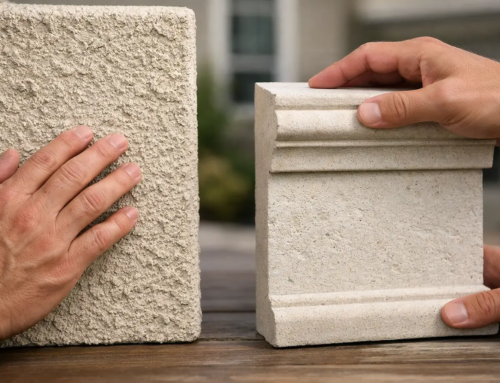
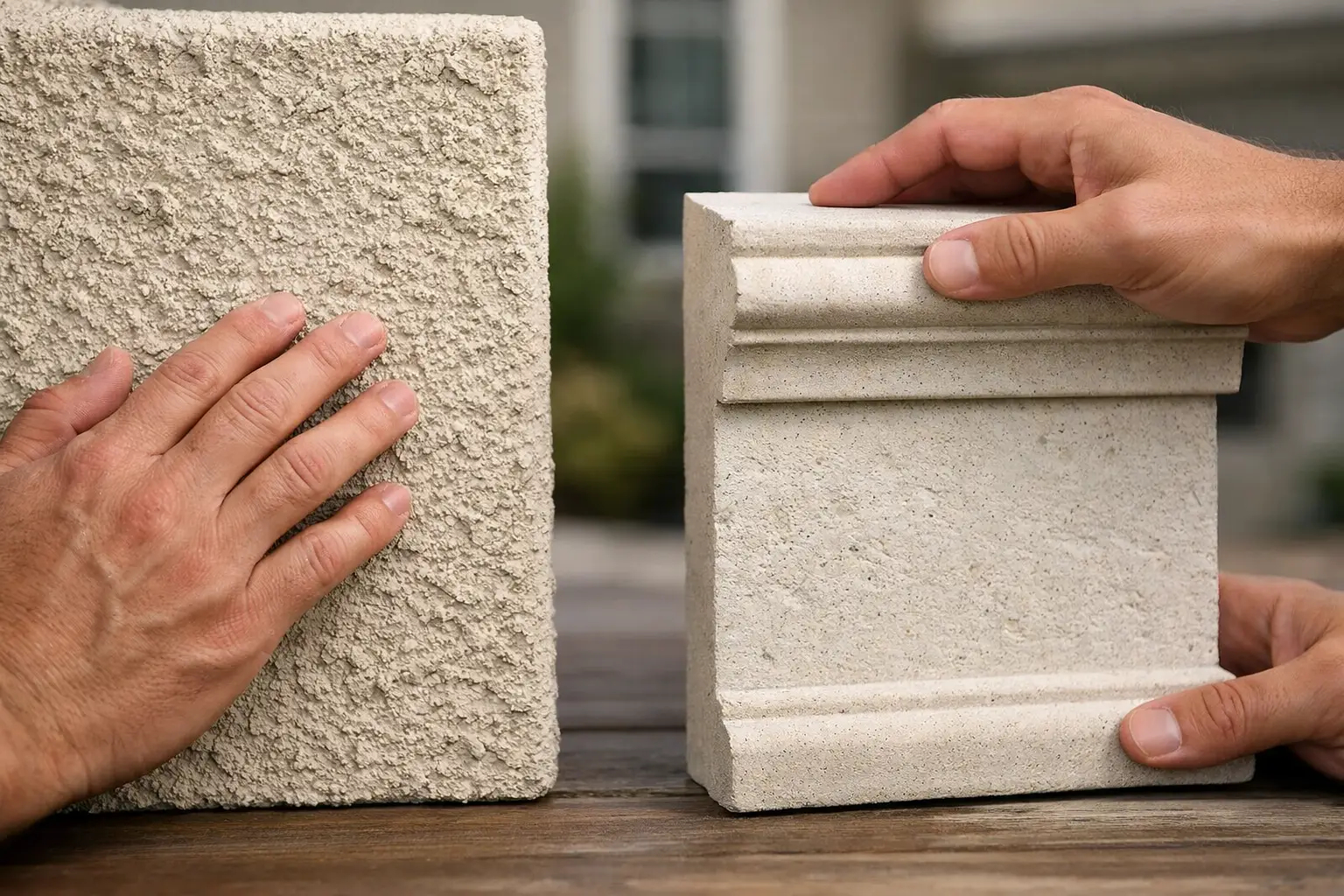
Put the approved sample beside the finished pieces in daylight. Cast stone can be colored with mineral colouring pigments, and that gives you range, but it also means your approval has to be tied to an actual benchmark. Compare base tone, surface texture, and the way the finish reads next to adjacent brick, limestone, or stucco. If the original sample was approved under warm showroom lighting, do not rely on memory when the pallets arrive at 8 a.m.
Uniformity is part of the value proposition here. Wikipedia notes that cast stone is more uniform than natural stone. That does not mean every unit will be visually identical, nor should it. It means you should expect controlled consistency from piece to piece. If one run looks sandy, another looks closed, and a third shifts noticeably in tone, document it before a single unit gets set.
Check edges, profiles, and overall consistency across units
Lay out multiple units and compare them as a group, not one by one. Sight along edges. Measure repeat dimensions. Check that returns, drips, arrises, and reveals line up across the run. If the work includes coping, sills, balustrade components, or stone moldings, consistency matters just as much as beauty because repetition amplifies small errors. A profile that drifts by even a little will read loud across ten pieces.
High standards are not abstract here. The Cast Stone Institute frames its certified members as meeting high quality standards for project work, and this is the stage where that claim should show up in the product. Clean cast lines, stable dimensions, and repeatable finish tell you far more than a sales sheet ever will.
Document any chips, cracks, or dimensional drift immediately
Inspect corners, edges, and bearing surfaces first. Note chips, cracks, broken returns, pallet rub, or any dimensional drift against the shop drawing. Photograph each issue with a tape measure in frame. Record unit counts, locations, and whether the piece is repairable, rejectable, or still acceptable for a concealed location. Do not rely on phone calls alone. A dated field log will save you later.
| Sign-Off Item | Accept When | Reject Or Hold When |
|---|---|---|
| Color and texture | Matches the approved sample within expected batch variation | Noticeably different tone or finish across the run |
| Profile and dimensions | Consistent with drawings and adjacent pieces | Drift affects alignment, joints, or appearance |
| Physical condition | No significant chips, cracks, or transport damage | Damage is visible after installation or affects performance |
| Documentation | Issues are logged and resolved before setting continues | Problems are “noted” but left untracked |
Common misses
6. Checklist the common misses before you close the job. These mistakes repeat because people treat every stone-like product as interchangeable. History should make you more careful, not less. Wikipedia traces the earliest known use of cast stone to the Cité de Carcassonne in France around 1138, and notes its extensive use in London in the late 19th century. Long history does not erase the need for precise modern decisions.
The most expensive mistake is assuming ‘stone is stone’—restoration work needs a closer match than new construction.
Don’t blur decorative Cast Stone with structural expectations
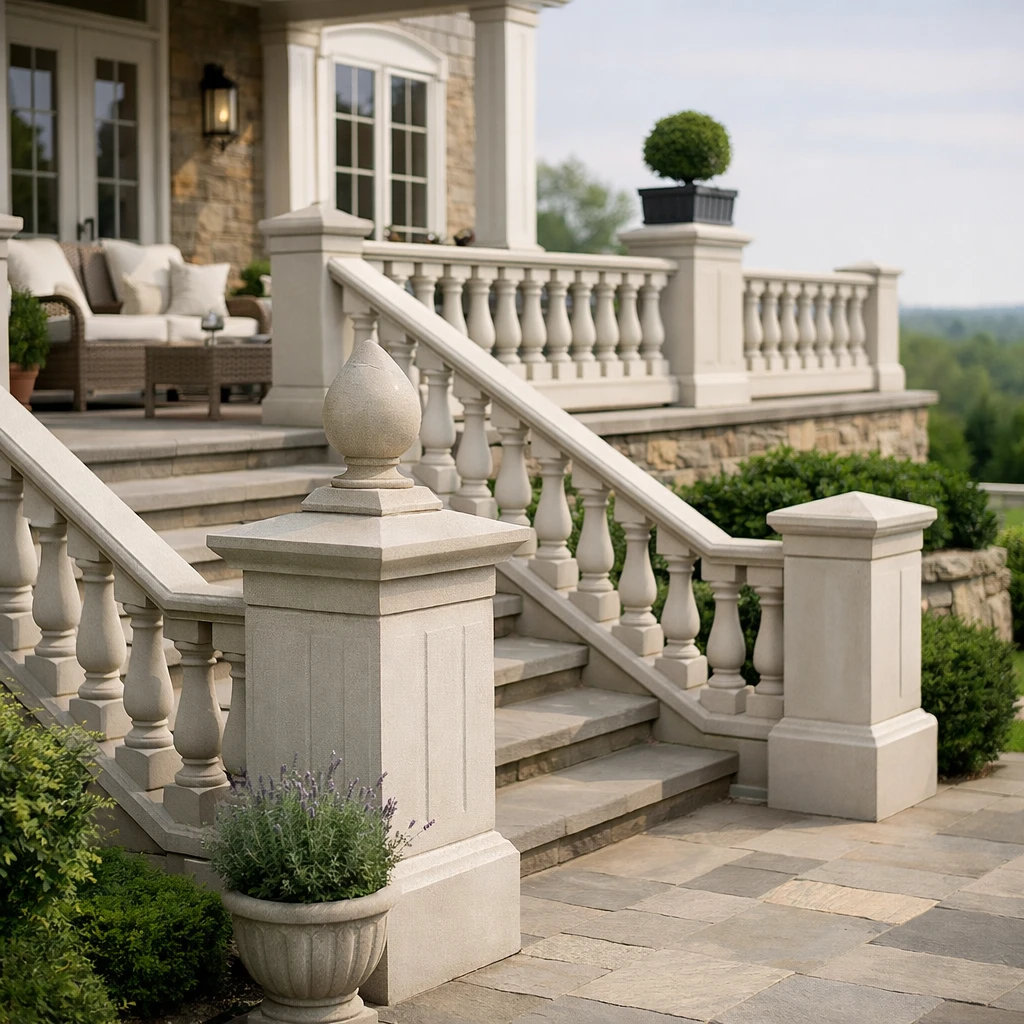
Keep the visual role separate from the structural role. A decorative surround, parapet screen, or balustrade should not quietly inherit structural expectations just because it looks substantial on paper. Confirm load paths, attachment logic, and impact exposure with the design team and installer. If a piece is expected to do more than trim, ask for that responsibility to be stated clearly in the drawings and details.
This sounds obvious, yet it slips on mixed-scope jobs all the time. One note says “architectural precast.” Another says “cast stone detail to match existing.” The mason reads one thing, the supplier reads another, and the owner assumes both mean the same system. They do not always mean the same thing.
Don’t skip restoration-specific matching on older buildings
Older buildings punish lazy matching. When the work is restoration, profile fidelity and weathered context matter far more than a generic “close enough” sample. Haddonstone explicitly includes restoration and replication in its cast stone offerings for a reason. An older facade in Queens or Boston will expose a wrong shoulder, radius, or drip edge instantly, especially when the original masonry has settled or softened over decades.
Ask for side-by-side comparison against the existing trim, not just a fresh standalone sample. Compare depth, shadow line, edge crispness, and how the new piece reads against mortar joints that may no longer be perfectly regular. Restoration matching is slower because it has to be slower.
Don’t assume every supplier follows the same standards
Standards vary. Systems vary. Documentation varies. New Cast Stone says it is a certified Tuscan Stoneworx cast shop using Tuscan Cast Stone Mix and casting systems, which is a useful example of a producer naming the process behind the product. You want that level of clarity from any supplier. Ask who designed the mix, who controls curing, what samples were approved, and what program governs consistency.
If you are reviewing products with Coral Cast or any other producer, request the proof that fits the scope: samples, shop drawings, handling notes, color options, and clear discussion of whether the work is stock, modified, or fully custom. That matters whether you are buying balustrade, coping, thin veneer, stone moldings, columns, or pier caps for a new build or a retrofit.
7. Checklist the final decision and request the right proof. Re-check the seven differences above and make the producer or installer show their work. The Cast Stone Institute offers resources for architects and designers, along with continuing education and events, and it says its Certified Producer Members meet high industry standards. New Cast Stone also frames its detailed system as making design easier and installation more straightforward. Those are useful claims only when they come with sample evidence, drawings, and field-ready details.
- Re-check the seven differences that affect the job.
- Ask for samples, shop drawings, and technical resources.
- Choose the producer or installer who can prove quality, not just claim it.
| Proof To Request | Why You Need It | What Missing Proof Usually Means |
|---|---|---|
| Approved sample | Locks in color, texture, and profile expectations | The finish can drift with no clean benchmark |
| Shop drawings | Confirms dimensions, joints, returns, and attachment assumptions | Field crews are forced to improvise |
| Technical resources | Supports handling, installation, and coordination | Risk gets pushed downstream to the installer |
| Quality program or certification | Shows how consistency is maintained | You are buying trust instead of evidence |
Labels are the start, not the answer.
The right call matches the building’s look, the unit’s weight, the site’s installation reality, and the producer’s quality controls. That is how “precast vs Cast Stone” stops being fuzzy and becomes actionable.
Before you approve the next Cast Stone order, which of these seven checks still lives only in someone’s memory instead of on paper?
Build With Coral Cast Confidence
Coral Cast combines Architectural precast concrete manufacturing, maintenance-free products, New York production, secure U.S. shipping, showroom help, and free estimates for homeowners, builders, architects, contractors, and property owners.
Generated on SEOPro AI