Wall Coping 101: How Precast Caps Protect and Beautify Your Walls
Rain gathers on the flat top of a garden wall and runs cleanly off the edges instead of soaking into the masonry. After a hard storm, the face of the brick still looks dry. The mortar joints stay intact. That quiet little detail up top just saved you trouble.
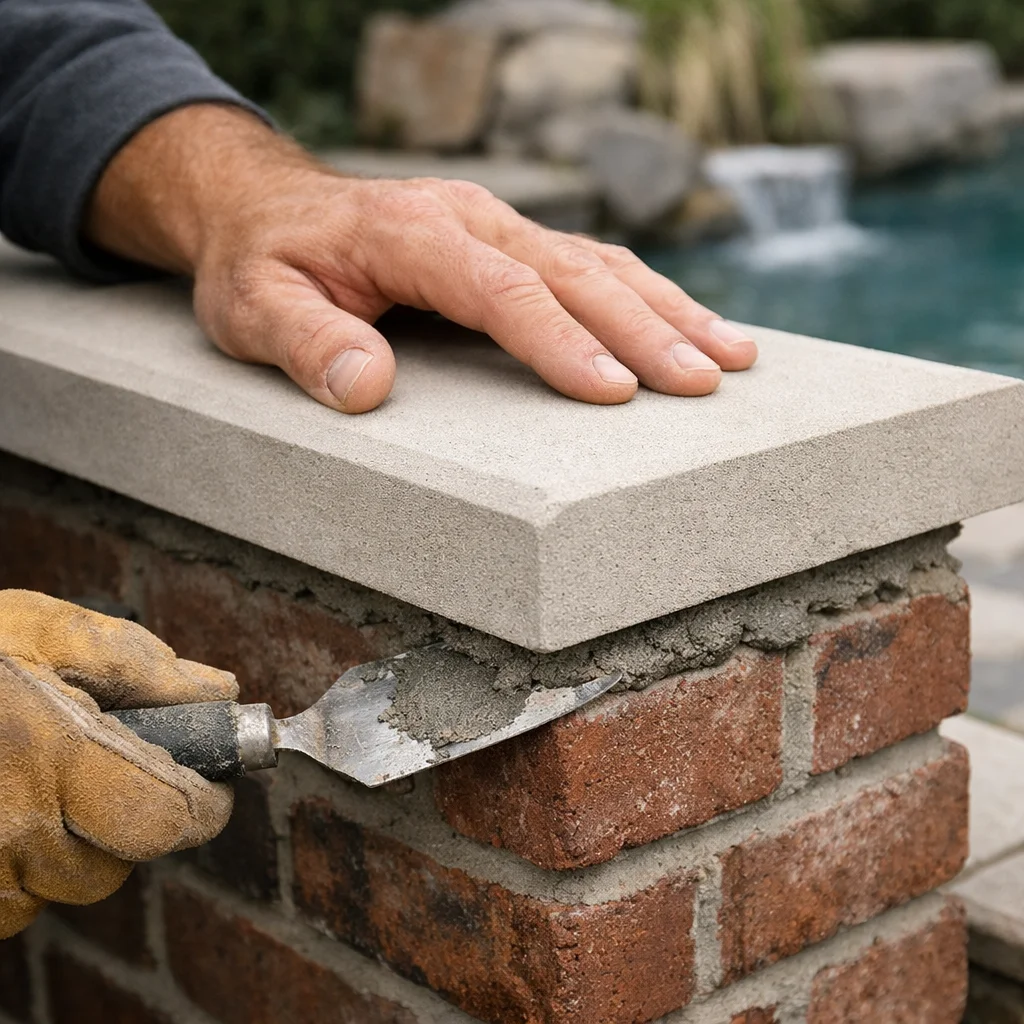
That detail is Stone Wall Coping in plain language: the cap that covers the exposed top of a wall, throws water clear, and gives the whole run a finished edge. You see it on low landscape walls, parapets, entry piers, and long retaining walls — anywhere weather can sit on an exposed horizontal surface and start doing damage.
If you have ever priced a wall repair, you already know why this matters. Water almost always finds the weak spot first. Good coping turns the top of the wall from a sponge into a shield, and it does it while making the project look intentional instead of unfinished.
#1 What Stone Wall Coping actually is
What it is
Wall coping is the top piece installed on a wall to cover the exposed edge and help shed water away from the masonry. Think of it as the roof for the wall. On a simple garden wall, it may read as a neat top band. On a taller parapet or formal entry pier, it becomes an architectural line that people notice from the street.
In supplier language, you will see wall coping grouped with related exterior details. Haddonstone USA, for example, places Cast Stone Wall Copings alongside walls, wall dressings, parapet screening, and pier caps. That is a useful clue. Specifiers do not treat coping as a random add-on; they treat it as part of the wall system.
A wall cap is not just decorative; it is the wall’s first defense against weather.
Why it matters
Without a cap, the top of a wall stays exposed to direct rain, standing water, sun, and freeze-thaw cycles. Moisture seeps into joints, the face stains faster, and the edge begins to break down long before the rest of the wall should. You can build with solid brick, block, stone veneer, or cast units — if the top fails, the wall ages harder and faster.
Quick example
Picture a 24-inch-high brick garden wall in Westchester. Leave the top flat and unprotected, and water sits right where the mortar is most vulnerable. Add a properly sized coping cap with a slight pitch and overhang, and that same wall starts pushing water away every time it rains.
#2 Why precast caps protect walls so well
What it is
Precast coping uses manufactured units instead of field-shaped pieces. That matters because you get repeatable sizes, controlled profiles, and a cleaner fit along a long wall run. Kerckhoffstone even frames the buying question around both appearance and performance in its article title, “Different Types of Wall Coping Stones and Their Benefits.” That is the right mindset: coping is never just a color choice.
The best coping protects the wall before anyone notices the finish.
Why it matters
When the units are made to consistent dimensions, you have a much better chance of getting straight lines, even joints, and predictable overhangs. On a 40-foot retaining wall, small inconsistencies multiply fast. One cap that runs wide, one that runs short, and one with a slightly different slope can make the whole top read wavy — and worse, it can let water track down the face instead of clearing it.
Precast and cast stone also make it easier to repeat details from one project zone to another. If you are capping a boundary wall, two gate piers, and a short parapet, manufactured pieces help those elements look related instead of pieced together.
Quick example
We see this constantly on long residential walls. A homeowner starts with the idea that “a cap is a cap,” then compares a clean precast run against mixed field-cut pieces. The difference shows up first in the joints, then in the corners, then in the water pattern after the first storm.
#3 Common materials and profiles to know
What it is
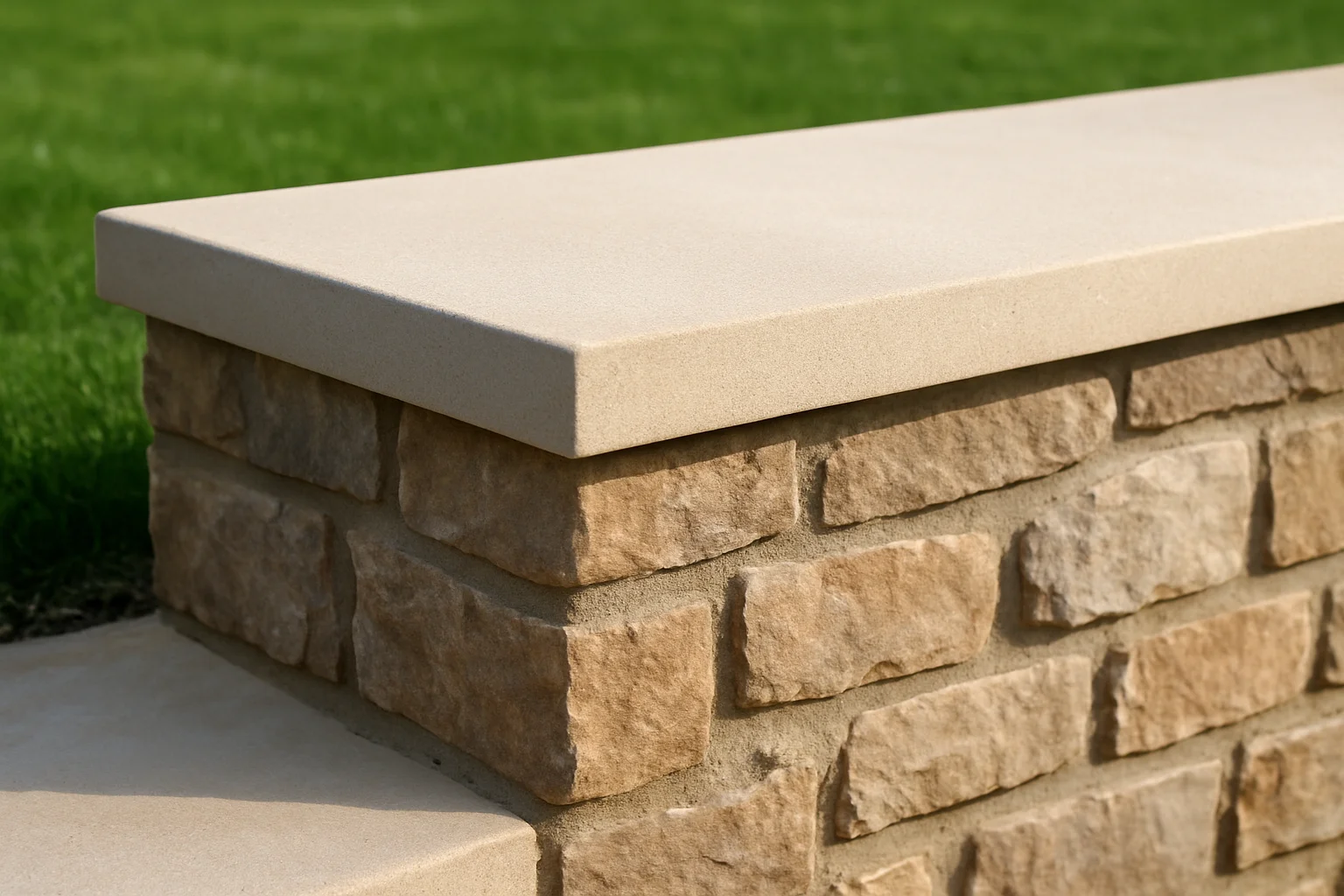
Most buyers run into two decisions at the same time: material family and edge profile. NT Pavers’ coping comparison content points to marble, travertine, limestone, and sandstone as common material options, and it also uses profile terms such as bullnose and squared edge. That tracks with real jobs. You are not only choosing what the cap is made of; you are choosing how its edge shapes the look of the wall.
Some suppliers emphasize natural stone. Others emphasize cast stone or precast concrete. That is not really a contradiction. It just reflects two different ways projects get specified: by natural material character, or by manufactured consistency and repeatability.
Material choice matters, but the edge profile often changes the whole look of the wall.
Why it matters
A rounded bullnose edge softens the wall and feels more traditional around pools, courtyards, or Mediterranean-style homes. A squared edge looks sharper and more architectural, especially on modern facades, parapets, and entry sequences. The wrong profile can make a well-built wall feel off by an inch, even if nobody can explain why.
| Option | What You Get | Where It Usually Fits Best |
|---|---|---|
| Marble | Refined, formal appearance | High-visibility accent walls and elegant exterior settings |
| Travertine | Warm, textured look | Poolside walls, patios, and relaxed residential landscapes |
| Limestone | Classic, understated character | Traditional homes, garden walls, and restrained facades |
| Sandstone | Natural grain and earthy color movement | Rustic or regionally styled hardscape work |
| Bullnose Profile | Rounded front edge | Softer, more decorative transitions |
| Squared Edge Profile | Crisp, straight face | Contemporary walls and disciplined architectural lines |
Quick example
Set the same beige coping material on two walls. Put a bullnose on one and a squared edge on the other. The first looks softer and more relaxed. The second looks cleaner and more formal. Same color. Same wall. Completely different read from the curb.
#4 Where wall coping is used most often
What it is
Wall coping shows up anywhere masonry has an exposed horizontal top. The obvious places are low garden walls and retaining walls, but that is only the start. Haddonstone USA groups coping with walls, parapet screening, and pier caps, while NT Pavers places pier caps and pool copings in the same exterior family. The categories overlap because the function overlaps too.
- Garden and boundary walls
- Retaining walls
- Entry piers and gate posts
- Parapets and roofline screening
- Pool-adjacent feature walls
- Commercial site walls and plaza edges
Any exposed horizontal masonry edge is a candidate for coping.
Why it matters
The most visible wall areas are usually the most exposed ones. Your eye lands on the top line first, and weather lands there first too. If the cap looks heavy, thin, crooked, or undersized, the entire project feels unresolved. If it drains badly, you will soon see streaks, failed joints, or damaged veneer below.
Quick example
A common residential setup is a front walk with two entry piers, a short flanking wall, and a matching planter edge. Cap all three with the same profile and finish, and the property suddenly looks designed as one composition instead of three separate masonry tasks.
#5 Sizes, thickness, and overhang: how to get the fit right
What it is
Coping is bought and built by dimension. StonesDirect lists one product as “2″ Thick, 14″ X 60″ – Ontario,” which tells you how specific these pieces can get. Thickness changes the visual weight. Width determines coverage. Length affects joint layout. Overhang controls how well water clears the wall face.
Measure the wall first, then choose the cap — not the other way around.
Why it matters
If the cap is too narrow, runoff can cling to the edge and stain the wall below. If it is too wide, the top can feel bulky and out of scale. If the lengths do not work with the wall layout, you end up with awkward small cuts at corners or ends. On a formal front elevation, those little misses stand out more than people expect.
You also want the cap to create a shadow line. That slight projection does more than look good; it helps separate the wet top surface from the wall face. On many projects, an overhang of roughly 1/2 inch to 1 inch per side gives you that visual and functional break, though the right amount depends on the wall thickness and style.
| Checkpoint | What To Verify | What You Avoid |
|---|---|---|
| Wall Width | Measure the finished top, not the unfinished block alone | A cap that ends up too narrow after veneer or stucco |
| Cap Width | Allow enough coverage for both sides | Runoff streaking down the face |
| Thickness | Match visual weight to wall height and style | A top that looks flimsy or overly heavy |
| Length | Plan joints, corners, and end conditions early | Tiny filler cuts and irregular spacing |
| Overhang | Keep projection consistent along the run | A choppy, uneven shadow line |
Quick example
Take an 8-inch finished wall. A flush cap may technically fit, but it often leaves water too close to the face. Step up to a wider cap with a modest overhang, and the wall immediately looks more deliberate while performing better in the next storm.
#6 Installation details that make a big difference
What it is
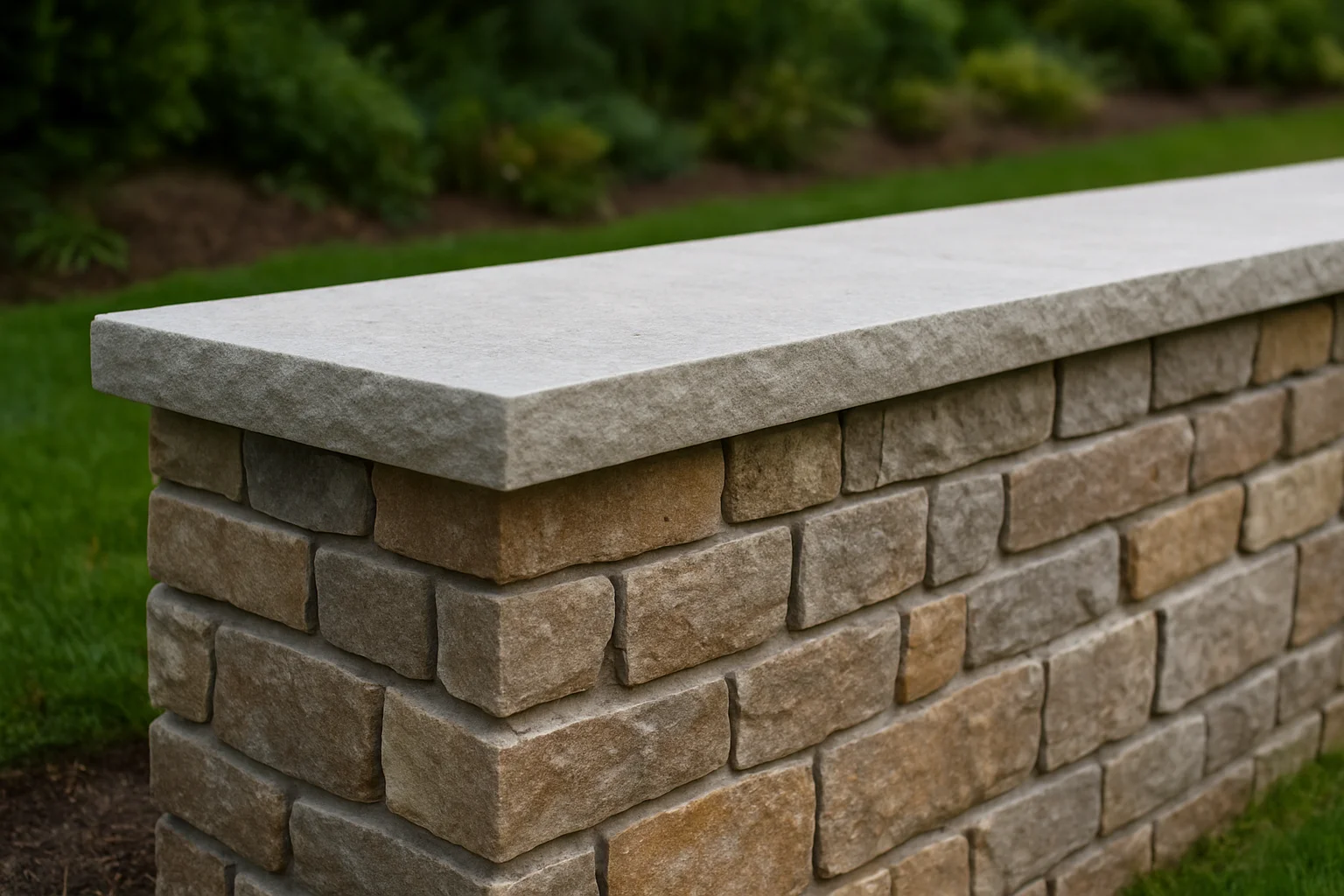
Good coping installation comes down to a few plain rules: create slope, keep alignment straight, maintain even joints, and preserve the overhang from piece to piece. These sound small. They are not. A cap can be the right material, size, and profile and still fail if the top surface holds water or the run wanders visually.
If the top surface holds water, the detailing needs to be fixed.
Why it matters
The top should pitch so water drains away instead of pooling. Joints should stay consistent so the run reads as one architectural line. Corners need to feel intentional, not improvised on site. On freeze-thaw jobs in New York, Boston, or Chicago, that attention matters even more because trapped moisture has a way of exposing every shortcut.
You should also think about the underside edge. If the cap has enough overhang and a crisp break at the edge, water is less likely to wrap back toward the wall face. That is the sort of detail you stop seeing once it is right — which is exactly the point.
Quick example
Imagine a mason setting a line of caps on a 30-foot boundary wall. He checks each piece with a level, adjusts the bed so the pitch stays consistent, and keeps the joints clean at every 60-inch section. When the run is done, the top looks calm. Calm is a sign of control.
#7 Maintenance, repair, and when to replace a coping cap
What it is
Coping needs less attention than many other exterior details, but it should not disappear from your maintenance list. Look for cracks, loose units, staining, open joints, and spalling at the top of the wall. Those are not just cosmetic issues. They are clues that water may already be getting where it should not.
The cap is usually the cheapest part of the wall to replace — and the most expensive to ignore.
Why it matters
When the top fails, the damage rarely stays at the top. Water moves down. You start with a cracked cap and end up repairing mortar, veneer, paint, or interior moisture problems nearby. The good news is that manufactured cast stone and precast units can often be replaced section by section, which makes targeted repairs much more practical than rebuilding an entire run.
Cleaning can solve surface dirt and mild biological growth. It will not solve movement, cracking, or failed joints. If a cap rocks under pressure, has separated from the substrate, or shows repeated winter damage, replacement is usually the honest answer.
Quick example
Say one cap on an entry pier cracks after a hard winter. If you replace that single piece early, you protect the masonry below and keep the repair tight. Wait two more seasons, and you may be rebuilding the pier corner instead of swapping one component.
How to choose the right option
Start with wall type and exposure
First, ask what the wall has to survive. Is it a low decorative garden wall, a retaining wall that sees splashback, or a parapet catching full weather? StonesDirect plainly welcomes both homeowners and contractors in its coping category, and that makes sense. This detail matters across the full range — from a backyard upgrade to a commercial site wall.
Choose the coping that fits the wall’s exposure first, and the style second.
Balance appearance, budget, and lead time
Next, decide how formal the wall needs to look and how much variation you want to tolerate. Product pages from Haddonstone, Kerckhoffstone, and NT Pavers all suggest the same buying reality: people compare coping by material family, profile, and application, not by color alone. If you need crisp repetition across many linear feet, manufactured precast often makes that easier. If you want a more organic surface character, natural stone may appeal more.
If you can visit a showroom or lay samples side by side, do it. A manufacturer such as Coral Cast can help you compare coping, pier caps, moldings, and other related pieces so the top detail matches the rest of the project instead of competing with it.
Confirm dimensions, edge profile, and install method
Before you place the order, lock down the measurements, edge shape, and installation approach. Confirm finished wall width, desired overhang, corner conditions, joint layout, and slope. Then ask one last practical question: can the installer keep that detail consistent from piece one to piece thirty?
| If Your Project Is… | Prioritize This First | Then Check |
|---|---|---|
| Low garden or boundary wall | Width and overhang for runoff | Profile that matches the home style |
| Entry piers or gate posts | Visual proportion and corner fit | Match with pier caps and nearby trim |
| Retaining wall | Drainage and durable installation | Long-run alignment and repeatable sizes |
| Parapet or exposed commercial wall | Weather exposure and consistent slope | Lead time, repeatability, and clean joints |
That short framework will get you farther than chasing color samples alone. When the coping fits the wall, the climate, and the design brief, the wall starts performing better and looking sharper on day one.
Stone Wall Coping does two big jobs in one small piece: it keeps water moving and gives the wall a clean, finished top line.
If you are planning a new wall or repairing an old one, slow down at the cap detail before you choose anything else. What would change on your project if you treated Stone Wall Coping as protection first and decoration second?
See Stone Options From Coral Cast
Coral Cast offers a large selection of maintenance-free precast and architectural stone for homeowners and trade teams, with New York manufacturing, free estimates, showroom guidance, and nationwide shipping.